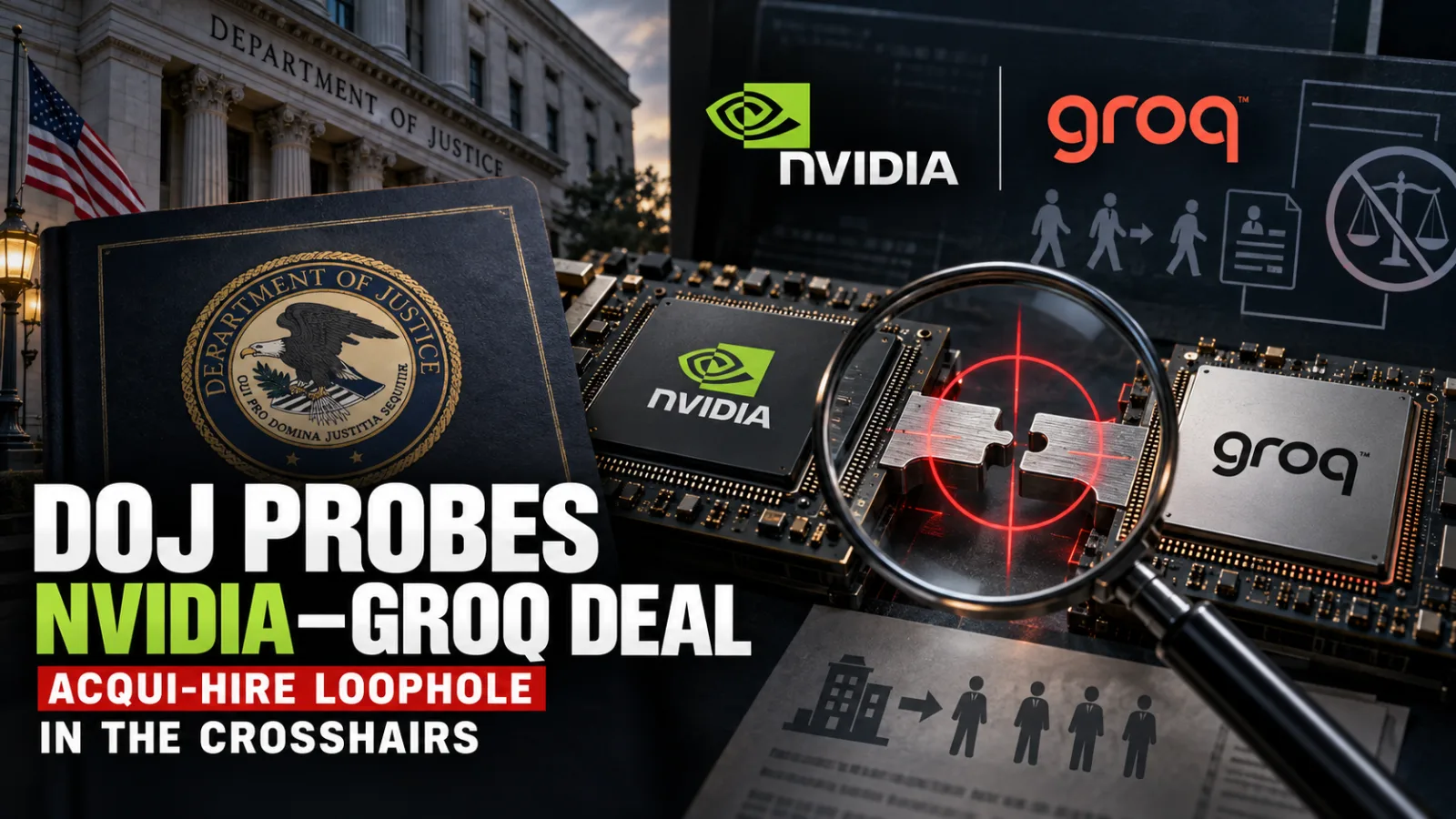
DOJ probe of Nvidia–Groq deal puts ‘acqui‑hire’ loophole in crosshairs
The U.S. Justice Department has opened a confidential investigation into Nvidia’s December licensing arrangement with Groq to determine whether the chip giant structured the deal to avoid antitrust review. The probe forces a legal reckoning over licensing-plus‑talent moves that have become common in AI M&A and could reshape how strategic partnerships are executed across the chip and AI ecosystems.
What happened
On Sept. 9, 2026, reporting from The New York Times and subsequent coverage from Reuters, Bloomberg Law and Axios revealed that the U.S. Department of Justice has opened a confidential inquiry into Nvidia’s licensing deal with AI‑chip startup Groq. The December agreement gave Nvidia rights to Groq technology while Groq remained an independent company; two senior Groq executives moved to Nvidia as part of the arrangement. The DOJ has reportedly sent Nvidia a formal demand for documents and information about the deal. (monorepo-sample2.nyt.net)
Why it matters
The inquiry targets a deal structure that regulators, lawmakers and competitors call a potential workaround to merger review: licensing technology, investing, and hiring founders rather than executing a traditional acquisition. If regulators conclude the deal functionally transferred control or eliminated effective competition without undergoing Hart‑Scott‑Rodino or other merger scrutiny, it could trigger fines, behavioral remedies, or new enforcement and guidance that would change how large platforms buy innovation.
This probe is a test case for whether the regulatory apparatus will treat complex licensing-plus‑talent arrangements as de facto mergers — and its outcome will reverberate through AI funding, chip supply strategies, and startup exit playbooks.
How the Nvidia–Groq arrangement worked (and where questions arise)
- December 2025: Nvidia and Groq announced a “non‑exclusive licensing agreement” that gave Nvidia rights to Groq’s inference‑focused chip designs and software. Groq officially remained independent. (monorepo-sample2.nyt.net)
- Key personnel moves: Groq’s CEO and COO reportedly moved to Nvidia as part of the transaction, a fact regulators flag when assessing integration and control. (news.bloomberglaw.com)
- Reported economics: media outlets have put the overall value of the arrangement at roughly $17–$20 billion when accounting for investments, licenses and associated warrants. That scale raises scrutiny because it approaches the economic footprint of a traditional acquisition. (investing.com)
The legal question is not purely semantic: antitrust thresholds hinge on whether the target retains independent governance, whether the acquirer gained exclusive or de facto control, and whether competition was materially reduced.
What regulators are looking for
The evidence that matters
Regulators typically seek lines of proof that show integration or elimination of competition. For this probe those include:
- internal communications and deal documents that reveal intent and how rights and options were structured;
- governance and contractual terms (board seats, veto rights, exclusive licensing clauses, equity warrants or options); and
- operational integration (product roadmaps, personnel reporting lines, and distribution or channel controls). (monorepo-sample2.nyt.net)
Winners, losers and short‑term market dynamics
- Startups: The ruling could narrow a commonly used path to liquidity — strategic backing plus talent hiring — making straight acquisitions or IPOs more likely but also more complicated.
- Big incumbents: Companies that used similar structures to scale quickly will face new compliance costs and deal friction. Nvidia specifically faces legal and reputational risk, and although the Times reporting notes fines are likelier than unwind orders, litigation risk and remedies could still be meaningful. (monorepo-sample2.nyt.net)
- Customers and the chip market: If enforcement chills these deals, smaller chip designers might find fewer deep-pocketed partners; alternatively, clearer rules could protect competitive supply and prevent dominant players from consolidating key pathways to talent and IP.
Why this is different from a normal merger review
Traditional merger review is triggered when share transfers or acquisitions cross statutory thresholds. Over the last three years, tech companies increasingly used hybrid structures — licensing, minority investments, hiring founders and absorbing key personnel — to create tight commercial ties without a classic takeover filing. Regulators have been warning about such “de facto” mergers; this inquiry is a concrete step from warning to enforcement. Bloomberg Law and Axios note that federal authorities and some senators had already asked agencies to scrutinize this model. (news.bloomberglaw.com)
Risks and second‑order effects
- Policy creep and deal drag: Firms may respond by widening legal reviews, slowing deal cadence, and adding protective covenants — increasing transaction costs and delaying product integrations.
- Global regulatory divergence: U.S. scrutiny could trigger separate probes in the EU, UK or other markets where competition authorities are already sensitive to vertical consolidation in AI stacks.
- Power consolidation vs. competition protection: Aggressive enforcement could reduce dominant firms’ ability to invest in startups, but lax enforcement risks durable concentration that harms customers and rivals.
What could happen next
The DOJ’s options range from closing the inquiry with no action to seeking fines, civil remedies or non‑litigation settlements that impose behavioral restrictions. Unlike a classic merger challenge that often seeks to unwind a past transaction, the DOJ may opt for tailored remedies (limitations on exclusivity, governance assurances, or prohibitions on certain integrations). Legal experts quoted by multiple outlets say fines are more likely than forced unwinds, but that outcome depends on the degree of operational integration and any evidence Nvidia sought to hide control. (monorepo-sample2.nyt.net)
For markets, the cleanest near‑term impact is procedural: expect more disclosures, more pre‑deal agency engagement, and a sharper line between permissible partnerships and transactions that must be reviewed.
Bottom line
The DOJ inquiry into Nvidia and Groq is not just an enforcement curiosity; it’s a structural moment for how powerful tech companies secure talent, intellectual property and market access in the AI era. Regulators will now have to decide whether to update enforcement practice to match novel dealcraft — a decision with real consequences for competition, startup exits and how AI hardware is commercialized.
Sources
- Regulators Are Investigating Nvidia’s Licensing Deal With Groq — The New York Times (Sept. 9, 2026)
- US DOJ probes Nvidia’s licensing deal with AI startup Groq — Reuters summary/coverage (Sept. 9, 2026)
- DOJ Probes Nvidia’s Tie‑Up With Groq on Antitrust Concerns — Bloomberg Law (Sept. 10, 2026)
- DOJ investigates Nvidia's deal with Groq — Axios (Sept. 10, 2026)