Nvidia’s $12.9B Hugging Face buy: the telemetry play reshaping AI
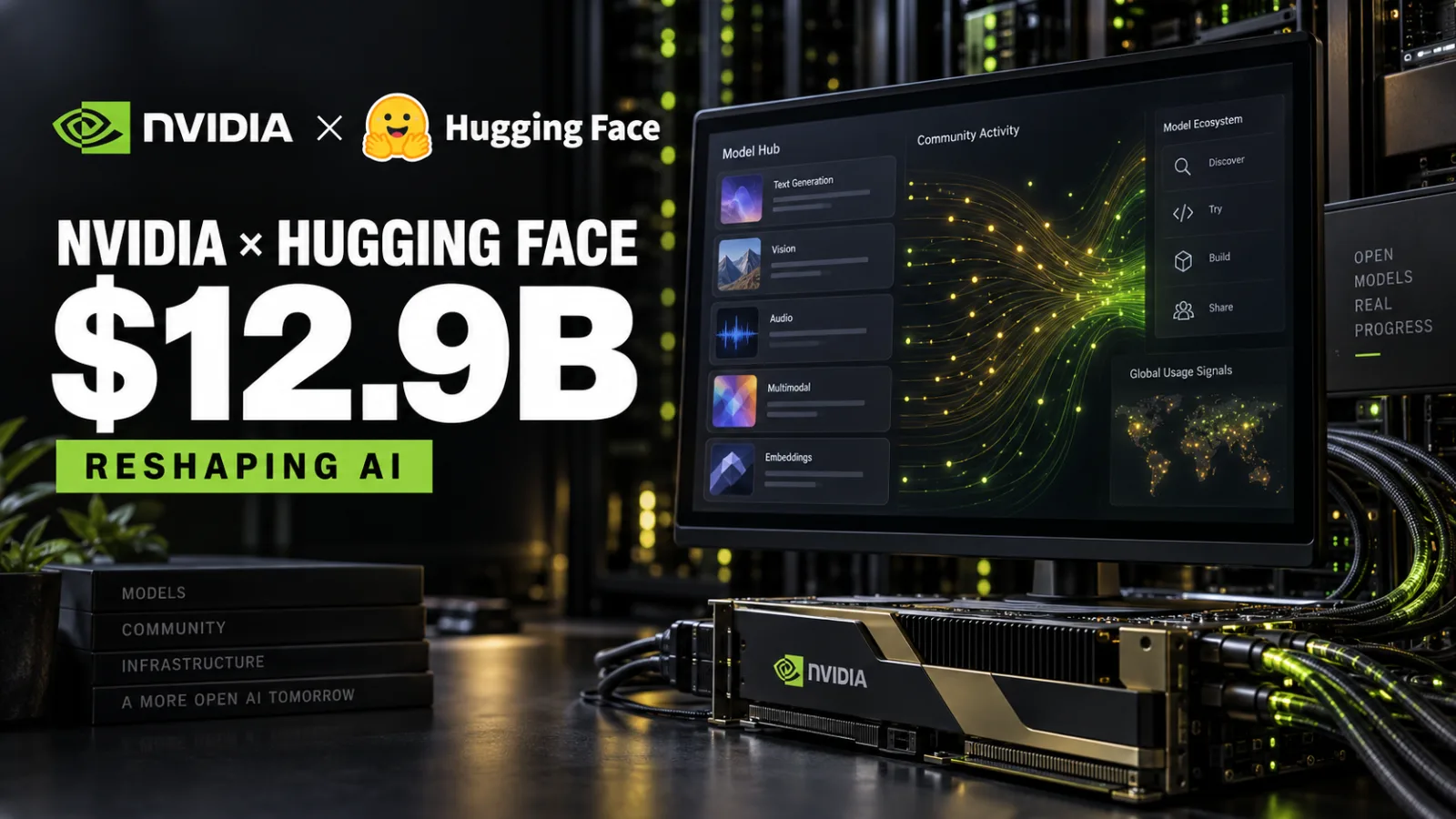
Nvidia announced a $12.93 billion purchase of Hugging Face, buying the model‑hub that millions of developers use and folding it into its DGX Cloud and AI stack. The deal is less about immediate revenue and more about real‑time developer and model telemetry that can steer where compute, software and standards land next.
What happened — in one line
Nvidia agreed to acquire Hugging Face for $12.93 billion in a deal announced in early September 2026; the purchase includes roughly $11.9 billion paid to shareholders plus an equity‑based retention pool of up to $1 billion for employees who join Nvidia. (blogs.nvidia.com)
Why this is consequential
Hugging Face is the internet’s model hub: a place where developers, researchers and enterprises discover, download, evaluate and deploy model weights, datasets and end‑to‑end applications. Nvidia’s acquisition gives it direct visibility into what models, datasets and workflows are trending — a stream of market intelligence that can be used to prioritize chip features, runtime optimizations and commercial bundles. That combination of telemetry + compute is the core strategic bet behind the price tag. (blogs.nvidia.com)
The deal buys Nvidia far more than a brand and codebase — it buys the faint signals of developer demand that will tell chip teams what to optimize next.
How the telemetry mechanism works (practically)
The components Nvidia now owns or controls
- The Hugging Face model hub (models, weights, metadata and download telemetry). (blogs.nvidia.com)
- Developer and enterprise signals: which models are being tuned, which datasets get paired with which architectures, and which deployment targets (on‑prem, public cloud, edge) are chosen. (investing.com)
- A pre‑existing DGX Cloud integration that already ties the hub to Nvidia’s multi‑node training and inference marketplaces. Nvidia can expand and deepen that connection now under common ownership. (nvidianews.nvidia.com)
Taken together, those pieces create a feedback loop: Hugging Face shows what the community is doing; Nvidia can ship optimized kernels, NIM microservices or runtime patches tuned for those exact patterns; enterprises can be nudged to reserve Nvidia DGX Cloud capacity to train or serve the same models. Over time the loop can tilt the ecosystem toward Nvidia‑friendly stacks without ever forcing users to use Nvidia hardware — simply by making the Nvidia path measurably easier and cheaper.
Immediate impacts (what to watch in the next 3–12 months)
- Model discoverability shifts: curated recommendations and ‘best‑performing on Nvidia’ badges could redirect developer attention. (blogs.nvidia.com)
- Faster hardware‑software co‑optimization: telemetry can shorten the cycle between an architecture trend and a chip/runtime tweak. (nvidianews.nvidia.com)
- Commercial bundling: tight DGX Cloud + Hugging Face workflows could create integrated offers for enterprises that want a one‑stop path from prototype to production. (nvidianews.nvidia.com)
Who wins — and who should be nervous
- Winners: Nvidia (more control over demand signals and a path to bundle software, tooling and compute); enterprises that prioritize a single integrated vendor for support and speed; and early‑stage model teams willing to trade neutrality for scale. (blogs.nvidia.com)
- At risk: competing public cloud platforms and chip startups that rely on neutral model registries to surface alternatives; parts of the open‑source community worried about platform neutrality and surveillance of usage; competitors that lose the first‑mover telemetry advantage. (investing.com)
Constraints and guardrails Nvidia faces
- Openness promises matter: Nvidia and Hugging Face both said the model hub will remain open and multi‑cloud, and Nvidia leaders have tried to reassure the community that models and weights won’t be locked to a single vendor. Those statements are a social and reputational constraint — if developers sense favoritism, they will migrate to alternatives. (blogs.nvidia.com)
- Legal and regulatory scrutiny: Nvidia’s SEC filings and public statements explicitly note risks from new regulatory regimes and competition reviews that could arise when a dominant hardware supplier acquires a critical software distribution point. Antitrust regulators in the U.S., EU and elsewhere will likely look at whether control of distribution and telemetry can be used to foreclose rivals. (sec.gov)
- Technical limits: many model authors publish under permissive licenses; downloads and forks can be mirrored. Telemetry is powerful, but not absolute — offline distribution and alternative registries (already emerging) reduce single‑point control.
The strategic calculus: why pay this price for a model hub?
Hugging Face’s revenue and margins — by publicly available numbers — do not justify the headline multiple on finance alone. The premium is the strategic option: owning the platform shortens the loop from developer insight to chip and software changes, and it makes Nvidia a gatekeeper for an enormous share of model discovery and deployment decisions. In practice that means Nvidia is buying a near‑real‑time market research engine, plus a developer community measured in the tens of millions. (investing.com)
Risks that could unwind the value
- Community flight: if a meaningful slice of the developer and academic community sees the hub as compromised, alternative registries or decentralized mirrors could siphon off the most valuable telemetry. (investing.com)
- Regulatory action: forced remedies, divestitures or behavioral remedies that limit how Nvidia can use telemetry or bundle DGX Cloud could blunt the strategic benefit. The company’s own 8‑K warns that evolving government rules around AI distribution and use are material risks. (sec.gov)
- Competitive responses: hyperscalers and chip rivals can accelerate investments in rival tooling, registry mirrors, or exclusive model marketplaces — any of which would fragment the dataset Nvidia bought.
Bottom line
Nvidia didn’t pay $12.93 billion primarily to capture immediate software revenue. It paid for access to developer behavior, model trends and a channel that can nudge where compute is bought and what code paths are optimized. That telemetry‑plus‑compute thesis is powerful: if Nvidia executes it without fracturing the community or triggering heavy regulatory remedies, the company stands to own a new layer of competitive advantage. If it stumbles on trust or regulation, the deal could decelerate into an expensive experiment in platform stewardship. (blogs.nvidia.com)