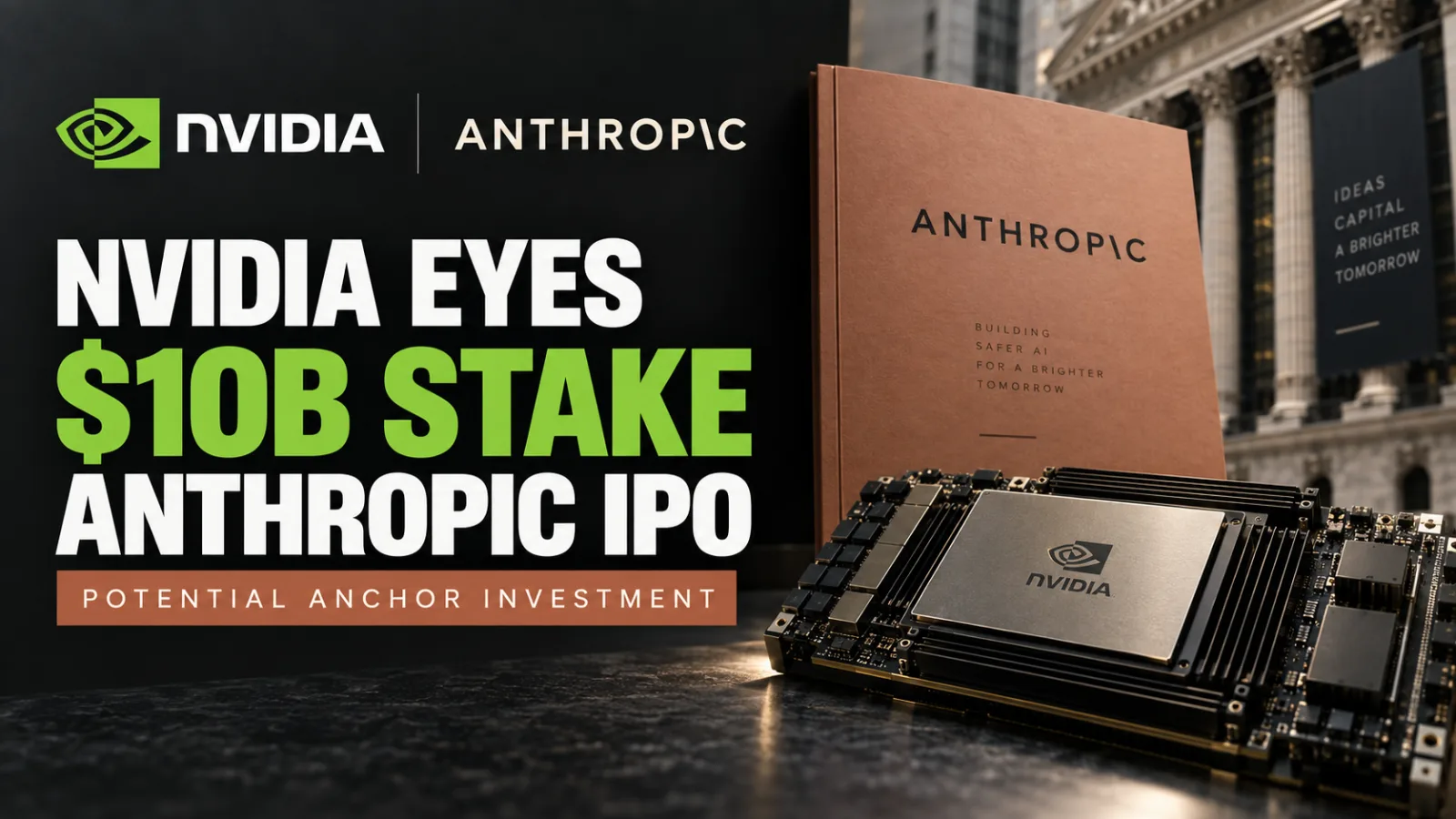
Nvidia eyes $10B stake to anchor Anthropic’s mega IPO
Reuters reports Nvidia is in talks to serve as an anchor investor for Anthropic’s planned IPO, possibly committing up to $10 billion. If true, the deal would deepen Nvidia’s commercial grip on frontier AI while reshaping investor appetite, compute contracts and regulatory scrutiny around the public listing.
What happened
Reuters reported Friday that Anthropic is in talks to add Nvidia as an anchor investor to a planned initial public offering that could raise as much as $100 billion and value the Claude maker at roughly $2 trillion. Nvidia is reportedly considering a contribution of up to $10 billion to the offering. (m.investing.com)
Why the number matters
A $10 billion anchor check—if it happens—would be one of the largest single pre‑IPO institutional commitments in modern markets and would signal unusually intense strategic alignment between a chip supplier and a frontier AI lab. It would also sit alongside earlier, large compute and cash commitments Anthropic has secured from major tech firms (Google’s multi‑billion commitments remain the biggest precedent). (bloomberg.com)
This isn’t a routine corner‑office investment: it would harden the commercial coupling between the world’s dominant AI accelerator vendor and one of the most valuable AI model companies, changing how markets, competitors and regulators read both firms.
How the deal would work (mechanics and incentives)
Anchor investments in large IPOs are typically negotiated as institutional allocations at a fixed price before the general offering is marketed. For Anthropic, Nvidia’s reasons are obvious: securing Cortex‑scale customers who buy massive GPU capacity helps guarantee long‑term demand for Nvidia’s H100/Blackwell family and any in‑house chips the company develops. For Anthropic, a marquee strategic backer provides underwriting confidence for an unusually large float and can help price an offering that relies on optimistic growth projections for model revenues and infrastructure plans. (m.investing.com)
Practical incentives include:
- guaranteed demand for servers and accelerated compute from a principal supplier;
- potential for preferential pricing, early access to new silicon and tighter performance tuning;
- reputational boost to anchor an offering that must convince public investors it can monetize frontier models at massive scale.
Why it matters: market, product and political consequences
1) Capital markets test: Anthropic’s IPO is already being sized as one of the largest in history. A deep strategic anchor from Nvidia would materially increase investor confidence that the company’s growth story can be underwritten, potentially validating the sky‑high headline valuation. (m.investing.com)
2) Commercial concentration: The move would further concentrate the compute–model axis. Nvidia’s chips power most production LLMs today; becoming a material shareholder in a leading model vendor binds the pair economically and operationally and raises questions about neutrality with other cloud and chip customers. That matters for customers, rivals and cloud partners who rely on an open hardware ecosystem. (bloomberg.com)
3) Regulatory and governance risk: A strategic investment of this size will invite scrutiny. Regulators and market watchers will ask whether Nvidia’s role as anchor creates conflicts—pricing, favoritism, or preferential access to capacity—and whether such arrangements should trigger additional disclosure, conditions or antitrust review. The deal would arrive against a backdrop of heightened regulatory attention to how chip and cloud deals shape market power in AI. (m.investing.com)
Winners, losers and constraints
Winners
- Nvidia: strengthens demand visibility, locks in a premier customer and converts hardware leadership into financial upside if Anthropic outperforms. (m.investing.com)
- Anthropic: gains a marquee backer that can calm IPO markets and cement long‑term price and capacity assurances. (m.investing.com)
Potential losers
- Competing chip vendors and smaller AI labs: the deal raises the bar for scale and could make it harder for rival silicon suppliers or model developers to compete for enterprise contracts.
- Some institutional investors: large pre‑IPO strategic allocations can make valuation less transparent and create governance complexities post‑listing.
Constraints and friction
- Financing logistics: deploying $10 billion requires board approvals, capital‑allocation tradeoffs and possible shareholder debate at Nvidia.
- Antitrust and disclosure: regulators in the U.S., EU and possibly other jurisdictions could probingly examine whether vendor ownership stakes in customers impair competition.
- Execution risk: Anthropic still must make its prospectus and marketing convincing to public investors. A strategic anchor helps, but a successful pricing and aftermarket performance depend on realistic forecasts and robust governance. (bloomberg.com)
What to watch next
- S‑1/prospectus timing: a public prospectus will reveal revenue, margins, compute commitments and any side letters or preferential terms to anchor investors—those clauses determine how much governance and economic control an anchor buys. (m.investing.com)
- SEC and competition watchdog comments: watch for pre‑emptive regulatory signals or requests for information from the DOJ, FTC, or the European Commission if the offering is large and linked to a strategic supplier.
- Market reception: whether institutional demand beyond any anchor can support a $100B raise and a ~$2T valuation; early investor books and aftermarket performance will decide whether the public markets accept frontier‑AI price multiples. (bloomberg.com)
Bottom line
Nvidia’s reported talks to anchor Anthropic’s IPO would be more than a headline finance story; they would be a deliberate bet that combining silicon and software upside is the fastest way to lock in AI leadership. The arrangement amplifies the commercial logic of integrated AI stacks—but it also concentrates risk, invites regulatory questions and forces public investors to price a new kind of vertically coupled AI franchise. Expect intense due diligence, heavy disclosure demands in the prospectus, and a public debate about whether strategic anchors of this size are a healthy feature of markets or a signal of too much concentration in a single vendor.