Meta’s Muse debuts — a personal AI that runs your digital life
Meta launched Muse on September 8, 2026: a cloud‑resident, connector‑driven personal AI agent that can act on your behalf across apps and services. The product bundles agentic workflows, a persistent secure VM with a browser, and paid tiers — a bet on convenience that immediately raises trust, privacy and competition questions.
What happened (and why I picked this story)
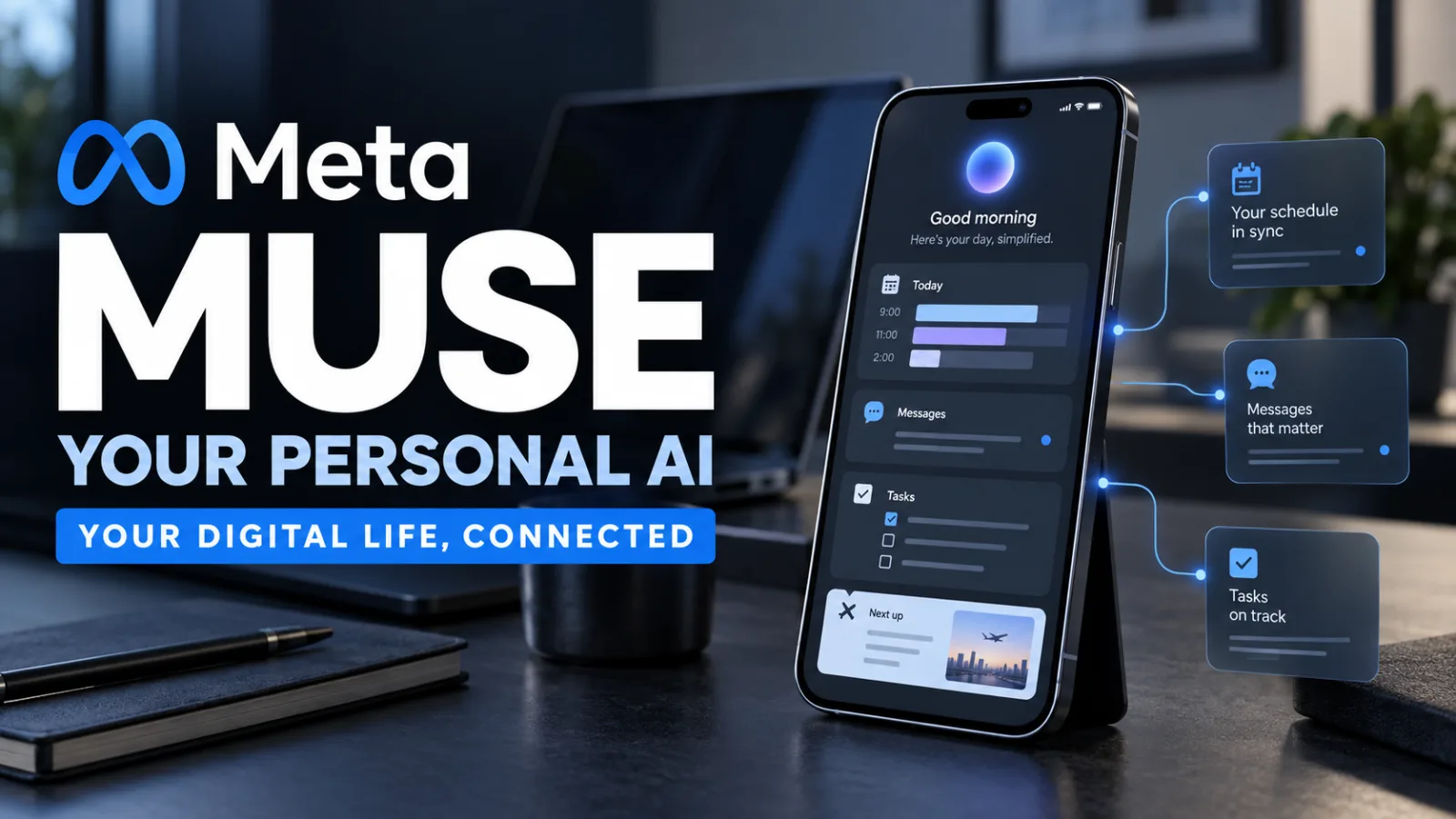
Meta announced Muse, a personal AI agent that lives in a persistent, secure virtual machine and can perform multi‑step tasks for users across WhatsApp, Instagram, Messenger and other connectors. The company published a product announcement and technical notes describing Muse’s architecture and safety controls, and mainstream outlets have already begun testing it. (about.fb.com)
Before choosing Muse as the lead report I scanned other big developments across categories — chip pricing and manufacturing, infrastructure and new AI research — to make sure this was the most consequential under‑covered shift this week. Those candidates included Intel price‑hike reports tied to a 2027 product cadence, OpenAI’s public statements about an “automated research intern,” and an industry update on High‑NA EUV wafer throughput; each is important, but none combine immediate consumer reach, new product mechanics, and regulatory risk the way a personal AI agent embedded across Meta’s social fabric does. (tomshardware.com)
How Muse works — the engineering in plain language
Muse is designed to be a persistent assistant you message like another person. Behind that chat it runs inside what Meta calls a “Muse Secure VM”: a dedicated cloud VM with a state‑of‑the‑art browser the agent uses to navigate the web, authenticate with services, and execute actions on the user’s behalf. Connectors tie Muse to third‑party services and to Meta’s own family of apps; Meta describes safety guardrails and graduated access controls it says limit risky behaviors. The company also released research notes explaining agent‑level safety design and how Muse Spark models power decisioning. (ai.meta.com)
Meta positions Muse as available via a standalone app and inside chat threads; it shipped with built‑in connectors and announced paid tiers — TechCrunch reports introductory paid plans called “Power” ($20/month) and “Maximum” ($100/month). Those tiers fold in additional capabilities, higher concurrency and more extensive connectors. (techcrunch.com)
Persistent VM, connectors and model plumbing
- Persistent VM: Muse’s persistent VM is the execution context for long‑running tasks (e.g., booking travel, negotiating returns), which lets Muse continue work after you close the app. Meta frames this as a convenience and a safety surface (the VM is a controlled environment rather than running on arbitrary endpoints). (ai.meta.com)
- Connectors: prebuilt integrations let Muse access calendars, shopping carts, messaging threads and business APIs; organizations can opt in or restrict specific connectors. (about.fb.com)
- Model stack: Muse runs on Meta’s Muse Spark family of models; Meta has published incremental updates to those models and a safety playbook for agents. (research.meta.ai)
Why this matters now
Muse is consequential because it changes the product framing for consumer AI from a passive Q&A assistant to an autonomous, ongoing agent with action capabilities inside services billions of people use.
Muse isn't just another chatbot — it's a decision‑making runtime parked inside Meta's social and commerce plumbing. That combination of reach and agency makes trust and access policy strategic problems, not just product ones.
Immediate implications include:
- Product reach: embedding an agent across WhatsApp and Instagram gives rapid scale and creates a powerful on‑ramp for people to adopt agentic workflows. (about.fb.com)
- Business models: paid tiers plus potential commerce integrations mean Muse is a direct monetization lever — and a data funnel — for Meta. (techcrunch.com)
- Regulatory pressure: an agent that can act for users raises data‑protection, authentication and consumer‑protection questions in multiple jurisdictions. (apnews.com)
Winners, constraints and risks
Winners
- Meta: immediate product differentiation and new revenue lines if users pay for higher‑capability tiers. (techcrunch.com)
- Businesses that integrate well: merchants and services that expose structured APIs will get better automation and higher conversion.
Constraints
- Trust and consent: users must grant broad, sensitive permissions — calendars, messaging contexts, payment flows — and Meta must convincingly isolate the agent’s actions and data. Early testers report convenience but also discomfort handing more of their digital life to an agent. (techradar.com)
- Technical correctness: agentic workflows multiply failure modes. A bad booking, mis‑authorized refund, or mistaken social message can scale quickly when an agent operates at the platform level.
Risks
- Privacy and regulatory backlash: regulators focused on data minimization and automated decisioning will scrutinize persistent agents that cross service boundaries. European and U.S. privacy frameworks could force stricter consent mechanics or data localization. (apnews.com)
- Marketplace foreclosure and competition: Meta’s control over connectors to its own ads, shopping and messaging stack creates a competitive dynamic that could disadvantage independent agent providers.
How Muse’s safety story stacks up
Meta released a long form explanation of safety measures for Muse, describing layered policy enforcement, human‑in‑the‑loop review points for high‑risk tasks, and technical limits for web automation. That document is credible as product intent, but it leaves several open questions: how connectors are vetted, what access tokens the agent receives and whether third‑party APIs can revoke agent actions in real time. Meta’s own research posts show iterative model improvements, but product controls will be the decisive bar for regulators and enterprises. (research.meta.ai)
Bottom line — what to watch next
Muse is a turning point in consumer AI: it makes autonomy and action the default product promise rather than a research footnote. That shift will accelerate commercial tie‑ins, spur competitive agent launches, and force fast regulatory scrutiny.
Watch for three immediate signals in the coming weeks:
- Uptake and retention metrics for Muse’s free vs. paid tiers (will consumers pay for active automation?). (techcrunch.com)
- Regulatory inquiries or clarifications about cross‑service automation and consent architecture. (apnews.com)
- New or restricted connector policies from major platforms and payment providers that either enable or throttle Muse’s capabilities.
Muse’s debut is both a product milestone and a policy inflection point. If it scales the way Meta hopes, the company will reframe how the market thinks about personal assistants — from helpful searchables into persistent executors — and the consequences for privacy, commerce and competition will be enormous.
Sources
- Introducing Muse: The World’s First Personal AI Agent Built for Everyone — Meta
- Muse product page — Meta AI
- How We Built Safety Into Muse — Meta AI Research
- Meta debuts Muse, its long‑planned personal AI agent — Axios
- Meta debuts its Muse AI agent. Will consumers trust it? — TechCrunch
- Meta launches Muse, personal AI agent — AP News